SEO vs PPC for Small Businesses: Which Should You Choose?
SEO vs PPC for small business: compare costs, results, and benefits to choose the right search marketing strategy for your budget.
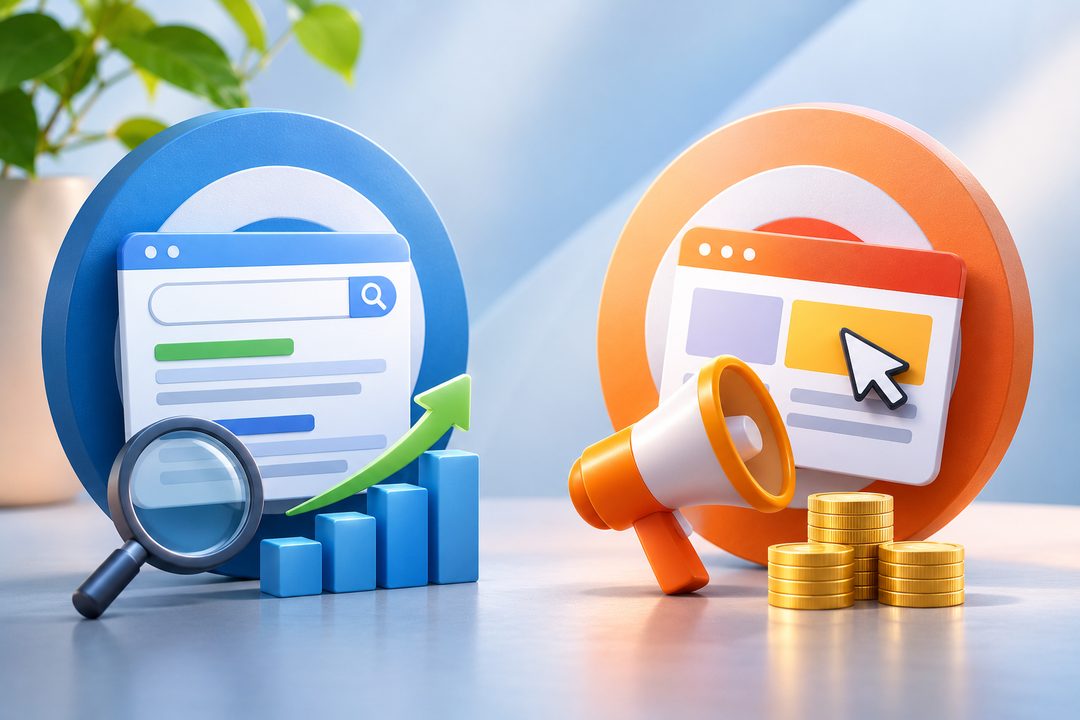
Deciding between SEO vs PPC for small business marketing can be challenging, especially when budgets are limited.
Both strategies help businesses appear in search results, but they work differently in terms of costs, visibility, and long-term results.
Understanding these differences can help you allocate your marketing budget more effectively.
What Is SEO?
Search Engine Optimisation (SEO) improves a website’s visibility in organic search results.
It involves optimising website content, technical performance, internal linking, and other ranking factors.
SEO generally requires ongoing effort, but successful optimisation can generate organic traffic over time without paying for each click.
What Is PPC?
Pay-Per-Click (PPC) advertising allows businesses to display paid advertisements on platforms such as Google Ads.
Advertisers typically pay when someone clicks their advertisement.
PPC can generate visibility relatively quickly, although results depend on campaign settings, competition, budget, and landing page quality.
SEO vs PPC: Key Differences
| Factor | SEO | PPC |
|---|---|---|
| Search visibility | Organic results | Paid advertisements |
| Cost structure | Optimisation investment | Advertising spend and management |
| Time to visibility | Usually gradual | Potentially immediate |
| Long-term traffic | Can continue over time | Depends on active campaigns |
| Targeting | Search intent and content | Keywords, audiences, and settings |
| Best for | Sustainable organic visibility | Targeted campaigns and promotions |
When Should Small Businesses Choose SEO?
SEO is particularly useful when businesses want to build long-term search visibility.
It can support:
- Informational and commercial keyword targeting.
- Local business discovery.
- Consistent organic traffic growth.
- Brand credibility through useful content.
However, SEO results take time and are not guaranteed.
When Is PPC a Better Option?
PPC may be suitable when businesses need to:
- Promote a new product or service.
- Generate traffic for a limited-time campaign.
- Test commercial keywords.
- Reach audiences with specific search intent.
Businesses should monitor advertising costs and conversion performance to avoid inefficient spending.
Can SEO and PPC Work Together?
Yes. Combining both approaches can help businesses balance short-term visibility with longer-term organic growth.
For example, PPC can support immediate campaign traffic while SEO builds visibility for relevant search queries over time.
Don’t Choose Between Visibility and Growth
SEO and PPC shouldn’t always be treated as competing strategies.
The better question is how each channel can contribute to your business goals.
NewGen’s SEO, SEM & Performance Marketing service supports businesses looking to improve their search visibility and digital marketing performance.
Whether you’re building organic traffic or planning paid campaigns, start with a strategy that reflects your budget, audience, and conversion goals.
Frequently Asked Questions
Is SEO cheaper than PPC?
SEO doesn’t charge per click, but it requires investment in optimisation. PPC involves advertising costs and potentially management fees.
Which delivers faster results, SEO or PPC?
PPC can generate visibility faster, while SEO generally requires more time to develop organic rankings.
Should small businesses use both SEO and PPC?
They can, provided the budget supports both strategies and each channel serves a clear business objective.
Related Insights

 NewGen
AI Chatbot vs Rule-Based Chatbot: Which Is Better?
AI chatbot vs rule-based chatbot: compare features, flexibility, costs, and use cases to choose the right solution for your business.
 NewGen
6 Signs Your Business Has Outgrown Spreadsheets
Discover 6 signs your business has outgrown spreadsheets and learn when custom software becomes a better solution.
 NewGen
Website vs Web Application: What's the Difference?
Website vs web application: understand the differences in functionality, development complexity, and business use cases.