
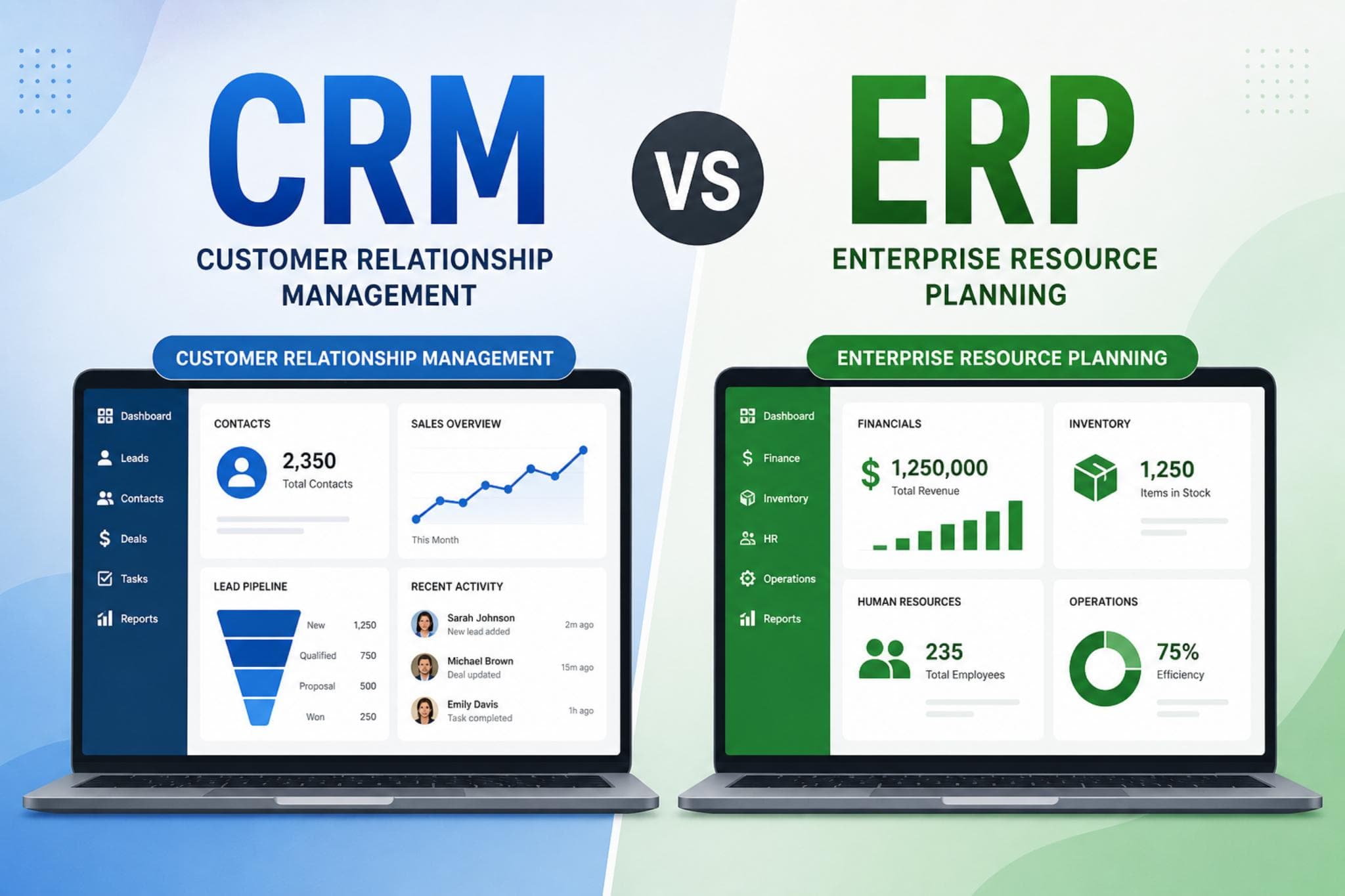
CRM vs ERP is a critical comparison for businesses looking to improve efficiency, manage operations, and scale effectively. Many companies struggle to decide which system they actually need because both CRM and ERP promise better performance—but they solve very different problems.
While CRM focuses on managing customer relationships and driving revenue, ERP is designed to streamline internal processes like finance, inventory, and operations. Understanding how they differ—and when to use each—is key to making the right investment for your business.
What Is CRM?
A Customer Relationship Management (CRM) system is software designed to help businesses manage interactions with customers, leads, and prospects. It acts as a central hub for all customer-related data, making it easier for teams to track conversations, nurture leads, and close deals.
CRM systems are primarily used by sales, marketing, and customer support teams to improve engagement and drive revenue growth.
Key features of a CRM system include:
- Lead and contact management
- Sales pipeline tracking
- Customer communication history
- Marketing automation tools
By using CRM software, businesses can gain better visibility into their sales process, improve customer retention, and create more personalized experiences.
What Is ERP?
Enterprise Resource Planning (ERP) is software that helps businesses manage and integrate their core internal processes. Unlike CRM, which focuses on customers, ERP focuses on operations—ensuring everything behind the scenes runs efficiently.
ERP systems are typically used by finance, operations, and HR teams to centralize business data and automate workflows.
Key features of an ERP system include:
- Accounting and financial management
- Inventory and supply chain management
- Human resources and payroll
- Procurement and reporting
With ERP software, businesses can reduce manual work, improve accuracy, and gain full control over their operations.
CRM vs ERP: Key Differences
To clearly understand CRM vs ERP, here’s a side-by-side comparison:
| Aspect | CRM (Customer Relationship Management) | ERP (Enterprise Resource Planning) |
|---|---|---|
| Primary Focus | Customer relationships & sales | Internal business operations |
| Main Goal | Increase revenue & customer retention | Improve efficiency & reduce costs |
| Users | Sales, marketing, customer support | Finance, HR, operations |
| Data Managed | Leads, contacts, customer interactions | Financial data, inventory, processes |
| Business Impact | Better customer experience & conversions | Streamlined workflows & accuracy |
| Example Use Case | Managing sales pipeline | Managing inventory & accounting |
CRM vs ERP: Use Cases in Real Business
Understanding CRM vs ERP becomes much easier when you look at how each system is used in real business scenarios. While CRM focuses on managing customer interactions and driving revenue, ERP is designed to streamline internal operations and ensure everything runs efficiently behind the scenes.
In practice, the choice between CRM, ERP, or a combination of both depends on your specific business challenges. The table below highlights common situations and which solution fits best.
| Business Scenario | Best Solution | Why It Fits | Business Impact |
|---|---|---|---|
| Growing sales pipeline | CRM | Helps track leads, automate follow-ups, and manage deals | Higher conversion rates |
| Managing customer relationships | CRM | Centralizes communication and customer data | Better engagement & retention |
| Handling inventory & supply chain | ERP | Tracks stock, orders, and logistics in real time | Reduced errors & better control |
| Financial reporting & accounting | ERP | Automates financial processes and reporting | Accurate and timely insights |
| Scaling operations and sales together | CRM + ERP | Aligns customer demand with operational capacity | End-to-end visibility |
| Eliminating data silos | CRM + ERP | Integrates customer and operational data | Smarter decision-making |
How to Scale Your Business with CRM or ERP
Choosing between CRM vs ERP is just the first step—what truly matters is how you use these systems to support long-term growth. When implemented correctly, both CRM and ERP can help businesses scale faster by improving efficiency, automating processes, and enabling smarter decision-making.
1. Automating Workflows for Faster Growth
One of the biggest advantages of using CRM or ERP systems is automation. CRM tools can automate follow-ups, lead nurturing, and sales processes, allowing teams to focus on closing deals.
On the other hand, ERP systems automate operational tasks such as inventory updates, invoicing, and reporting. This reduces manual errors and speeds up business processes, making it easier to scale without increasing overhead.
2. Leveraging Data Across the Organization
Both CRM and ERP systems provide valuable data—but in different ways. CRM offers insights into customer behavior, preferences, and sales performance, while ERP provides data on financial health, operations, and resource management.
By leveraging this data, businesses can make smarter, data-driven decisions. Whether it’s optimizing marketing campaigns or improving supply chain efficiency, having the right information is a major competitive advantage.
3. Partnering with the Right Development Team
While many businesses start with off-the-shelf solutions, these tools often fall short as companies grow. Limited customization, integration challenges, and scalability issues can become major obstacles.
This is where working with a development partner becomes crucial.
At NewGen Development, businesses can build custom CRM and ERP systems tailored to their exact workflows. Instead of adapting your processes to fit the software, the software is designed to fit your business.
Custom solutions also make it easier to integrate CRM and ERP into one seamless ecosystem, ensuring data flows smoothly across all departments and supporting long-term growth.
Conclusion
Understanding CRM vs ERP comes down to recognizing their core roles in a business. CRM systems are built to drive customer engagement and revenue growth, while ERP systems are designed to optimize internal operations and efficiency.
There’s no one-size-fits-all answer—choosing between CRM and ERP depends on your business needs, challenges, and growth stage. In many cases, the most effective solution is a combination of both.
If your business is ready to scale and you’re still deciding between CRM, ERP, or a fully integrated system, partnering with the right team can make all the difference.
NewGen Development specializes in building custom CRM and ERP solutions that align with your business goals, streamline operations, and support long-term scalability.
🚀 Explore our services and start building the right system for your business!